
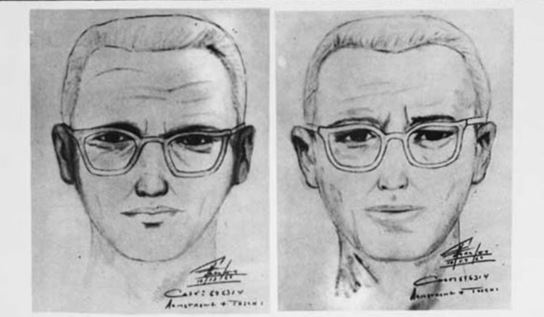
The Zodiac Killer announced himself with one chilling phone call. It came shortly after midnight on July 4, 1969. The Vallejo Police dispatcher picked up what sounded like a routine holiday complaint. Instead, a low, monotonous voice took credit for a double shooting at Blue Rock Springs Park. Then he added a casual postscript: “I also killed those kids last year. Goodbye.”
The Zodiac Killer hunted Northern California in the late 1960s and early 1970s. He did not simply kill. He staged a public spectacle. Cryptic ciphers, taunting letters mailed to newspapers, and a hand-stitched executioner’s hood marked with his crossed-circle symbol paralyzed the San Francisco Bay Area. He turned himself into one of America’s most enduring mysteries.
More than fifty-five years later, the case remains one of the most obsessively searched and studied unsolved serial murders in history. It forms a labyrinth of misdirection, media manipulation, and unbroken codes. Those elements still frustrate investigators and captivate the public. This post walks through the timeline of the attacks, the taunting letters, the cryptic ciphers, modern code-breaking efforts, and the psychological terror of a predator who claimed he would be reborn in paradise—yet vanished without a trace.
The Murders That Terrorized Northern California
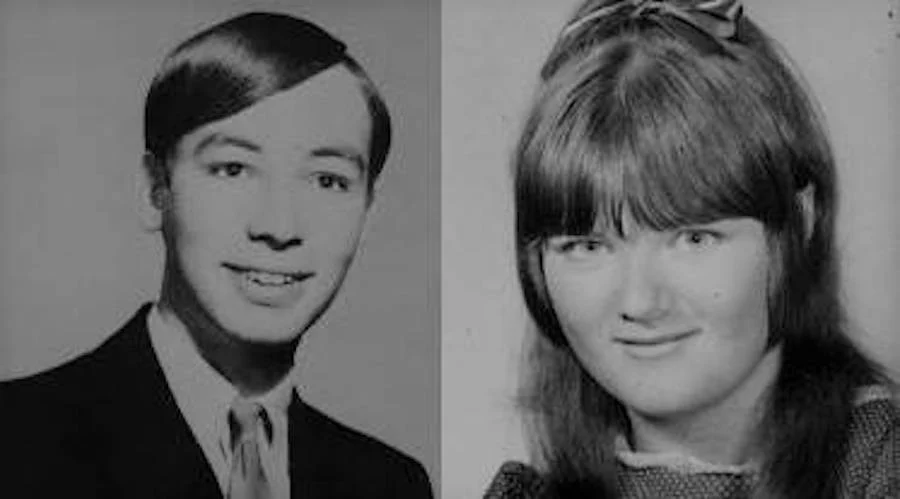
The Zodiac Killer’s confirmed attacks began on the night of December 20, 1968. High school students David Faraday, seventeen, and Betty Lou Jensen, sixteen, sat parked in their Rambler on a desolate stretch of Lake Herman Road in Benicia. The killer forced them from the vehicle and shot them both. Faraday died instantly. Jensen fell as she tried to run.
Seven months later, on July 4, 1969, Darlene Ferrin, twenty-two, and Michael Mageau, nineteen, sat in a parked car at Blue Rock Springs Park in Vallejo. A man approached with a flashlight and opened fire with a 9mm handgun. Ferrin died from her wounds. Mageau survived and gave the first physical description of the gunman.
The killer escalated the drama on September 27, 1969, at Lake Berryessa. College students Bryan Hartnell, twenty, and Cecelia Shepard, twenty-two, relaxed by the water. A man in a black hooded costume—white crossed-circle symbol on the chest—approached them. He bound the couple and stabbed them repeatedly. Shepard died. Hartnell survived.
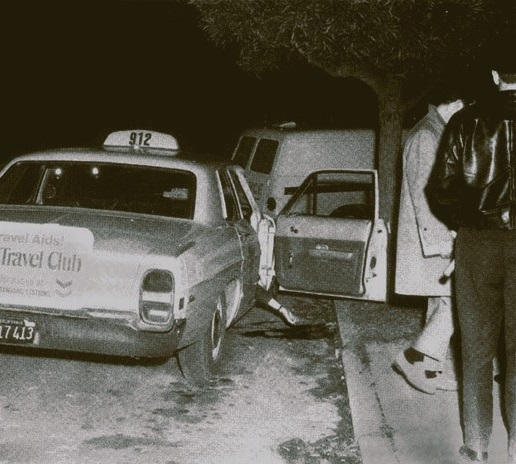
On October 11, 1969, the Zodiac struck in San Francisco’s Presidio Heights. He shot cab driver Paul Stine, twenty-nine, point-blank in the head. He wiped down the cab interior, tore away a piece of Stine’s blood-soaked shirt, and disappeared into the night.
The Taunting Letters and Media Manipulation
The Zodiac separated himself from other predators through masterful psychological warfare. Starting in July 1969, he mailed letters to Bay Area newspapers. Each one opened with the now-infamous line: “This is the Zodiac speaking.” The letters included specific, non-public details about the crimes. Those details proved the writer was the killer.
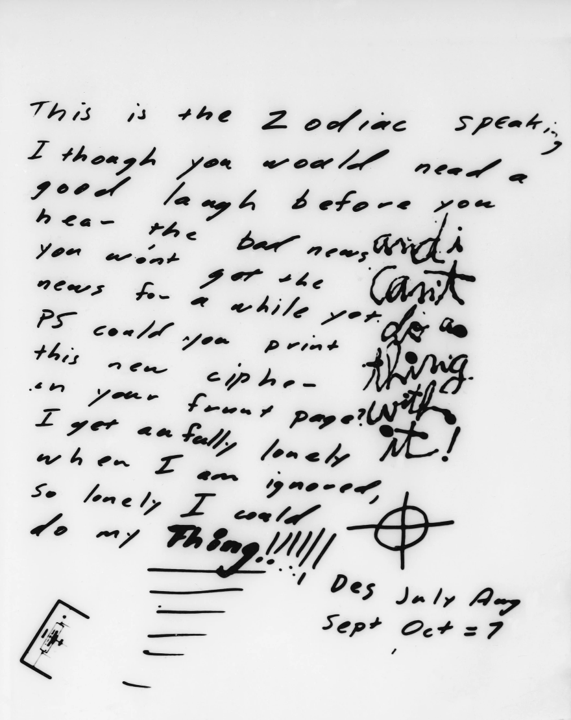
He demanded front-page publication of his ciphers. He threatened more violence if editors ignored him. After the Stine murder, he mailed a bloody scrap of the driver’s shirt to the San Francisco Chronicle. Later letters raised the stakes: he promised to shoot out school-bus tires and pick off children as they exited. The correspondence featured deliberate misspellings, bizarre symbols, and dark humor. He mocked law enforcement and seized control of the public conversation.
The Cryptic Ciphers
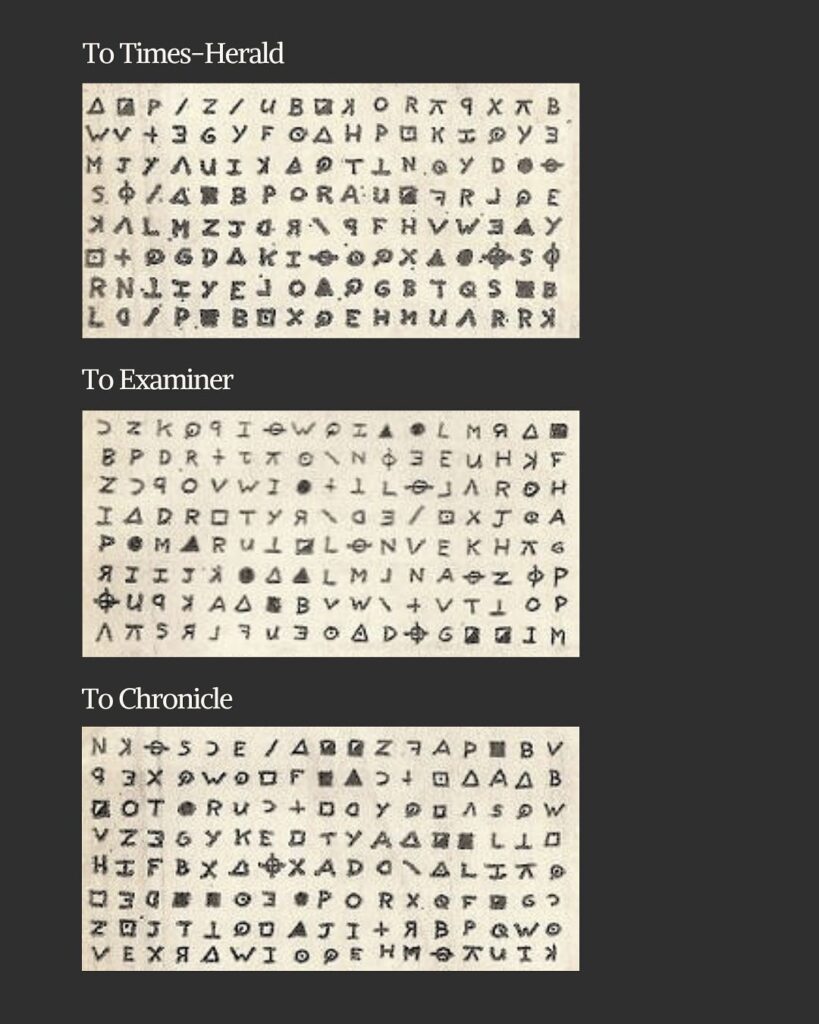
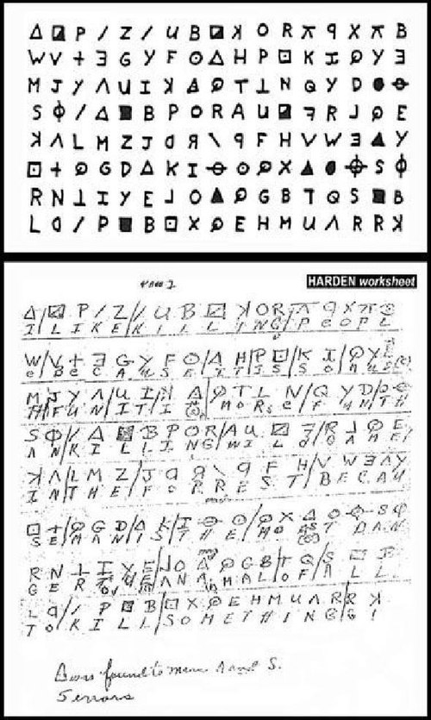
The letters terrified readers, but the ciphers became the Zodiac’s greatest intellectual challenge. In July 1969, he mailed the 408-symbol cipher—known as Z408—in three parts to local newspapers. A Salinas schoolteacher, Donald Harden, and his wife, Bettye, solved it within days. The decoded message revealed a chilling glimpse into the killer’s mind: “I like killing people because it is so much fun. It is more fun than killing wild game in the forest because man is the most dangerous animal of all.”
In November 1969, the Zodiac sent the far more complex 340-symbol cipher, Z340. For fifty-one years, it defied the FBI, the NSA, and thousands of amateur code-breakers.
He also mailed shorter ciphers, including the thirteen-symbol Z13 in April 1970. It came with the taunt: “My name is —.” These puzzles were never mere games. They served as psychological weapons. They humiliated authorities and asserted the killer’s superiority.
Modern Code-Breaking Attempts and Breakthroughs
The Z340 remained unbroken until December 2020. An international team—American software developer David Oranchak, Australian mathematician Sam Blake, and Belgian programmer Jarl Van Eycke—finally cracked it. They used custom software and sophisticated pattern analysis. The solution exposed the killer’s structural trick: a complex “period 19” transposition that required reading diagonally across the grid.
The decrypted message reinforced his arrogance: “I hope you are having lots of fun in trying to catch me… That wasn’t me on the TV show.” He repeated his lack of fear of the gas chamber and his belief that his victims would serve him as slaves in the afterlife.
The breakthrough mattered, yet the shorter Z13 and Z32 ciphers still resist every attempt. Even today’s computational power cannot solve them all.
The Psychological Terror and Enduring Obsession
The true horror of the Zodiac lay in his twisted worldview. He cast himself as a collector of souls who would be reborn in paradise. His victims, he claimed, would serve him as eternal slaves. By threatening random violence, mocking the police, and wearing theatrical costumes, he transformed into a mythical figure. His presence could be felt anywhere.
More than five decades later, the case refuses to fade. Investigators have poured over every lead. They have named numerous suspects. Yet no one has ever been definitively identified as the Zodiac Killer. That absence of resolution keeps the mystery alive—a phantom who controlled the narrative from his first phone call and vanished without a trace.
The Zodiac Killer: Legacy of a Phantom
The Zodiac turned Northern California into his personal hunting ground and the newspapers into his private stage. He gave the world his symbol, his twisted philosophy, and his voice. Yet he kept his true identity completely hidden. In doing so, he created one of the most chillingly orchestrated unsolved cases in American history.
Every new suspect or claimed cipher breakthrough pulls us back into the late 1960s. We still hope for the cinematic ending that reality has so far denied. The Zodiac Killer remains a dark, permanent stain on the history of American true crime—one that continues to defy resolution.
Have you followed the Zodiac Killer case? Do you have thoughts on why some mysteries refuse to let go? Share in the comments or submit your perspective via our contact form.